

Side Return or Rear Extension? How to Choose, and What Each Costs
Updated: 3 days ago
Most people arrive at this decision with a shape in mind rather than a problem. They have seen a side return in a neighbour's house, or a rear extension in a magazine, and they want that. The better question is which one your house is actually asking for.
They are not interchangeable. They cost different amounts, they take different routes through planning, and they solve genuinely different problems.
What each one actually is
A side return fills in the narrow alley that runs along the back half of a Victorian or Edwardian terrace, the strip of dead ground beside the original back addition. You are not pushing into the garden. You are claiming land you already own and currently use for nothing.
A rear extension pushes the back wall of the house further into the garden. You gain depth across the full width of the house, and you lose garden in exchange.
A wrap around does both. It is a side return and a rear extension in one build, and it is the option most often reached for when the ground floor needs to change completely rather than get bigger.
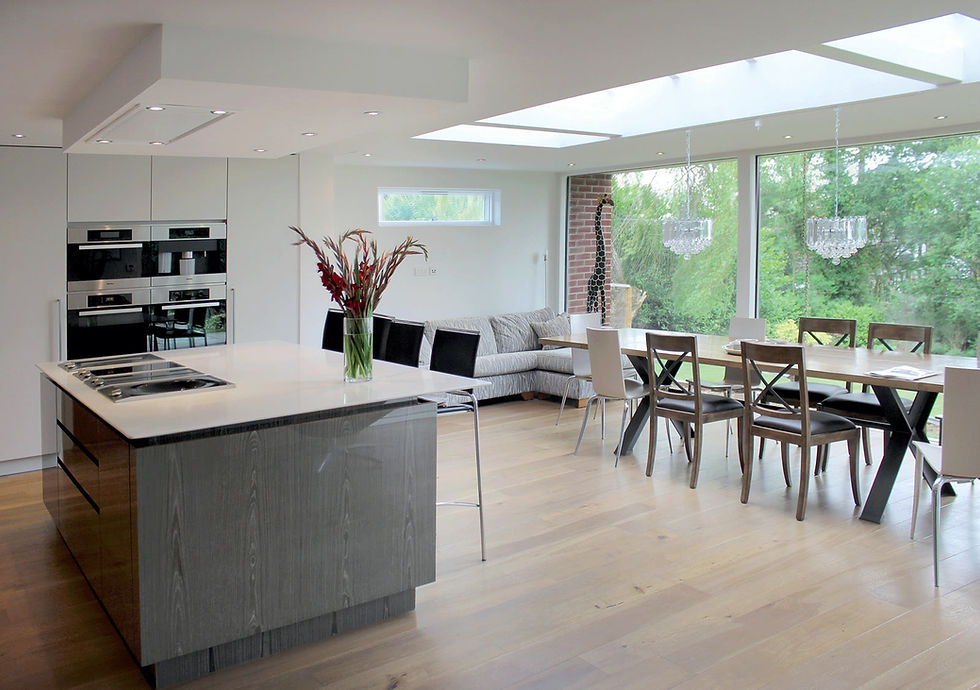
The costs
Rear extension: £280 to £320 per square foot
Side return extension: £310 to £340 per square foot
The side return costs more per square foot, which surprises people, because it looks like the smaller job. The reason is structural. A side return usually means removing a substantial part of the original external wall and carrying the load above it on steel. A rear extension often leaves more of the existing structure intact.
For comparison, across the rest of the work we do:
Full renovation: £160 to £350 per square foot
Loft conversion: £250 to £300 per square foot, the cheapest way to extend a London house
Basement excavation: £450 to £500 per square foot
Super prime specification: £500 to £800 per square foot
Those are London figures for the standard of work we do. They are not national averages and they are not the cheapest quote you will find.
For the detail behind two of those bands, see rear extension cost in London and loft conversion costs in London.
How to choose
Choose a side return if the back of your house is dark, the kitchen is narrow, and there is a useless alley beside it. This is the classic London terrace problem and the side return is the classic answer. You keep your garden. You get width where the house currently pinches.
Choose a rear extension if the garden is deep enough to lose some, and what you need is a bigger room rather than a wider one. A rear extension gives you depth across the full width, which suits a house that is already reasonably wide but shallow at the back.
Choose a wrap around if the whole ground floor is wrong and you are prepared to rebuild how it works. It costs the most and disrupts the most, and it is the only one of the three that genuinely changes the plan of the house rather than adding to it.

The three things people underestimate
Light is not a function of floor area. A badly glazed extension can make a kitchen darker by burying the original back window under a new roof. Where the glass goes matters more than how much of it there is.
The party wall is a process, not a formality. If you are building up to or along a shared boundary, you will need a party wall surveyor and your neighbour will need notice. Start that conversation early and it is administration. Start it late and it is a delay.
Planning is not the only permission. Building control, structural calculations and, on many terraces, your neighbour's agreement all sit alongside it. A scheme can have planning permission and still not be ready to build.
The party wall process is explained in party wall agreements, what they cost and who handles them.
Which one adds more value?
The honest answer is that neither adds value reliably on its own. What adds value is a ground floor that works, light where you spend time, storage where you need it, a plan that suits how the household actually lives. We have seen small, well-resolved side returns do more for a house than large, poorly planned rear extensions.
If the extension is the whole plan, it is usually the wrong plan.
How we approach it
We are a design and build contractor in Fulham, West London, working across Chelsea, Kensington, Fulham and the surrounding prime postcodes. Architecture, interior design, project management and construction sit under one contract, which means the person who designs your extension is accountable for what it costs to build.
If you are weighing a side return against a rear extension on a specific house, we would rather look at the house than guess. That conversation costs nothing.
Weighing a side return against a rear extension on a specific house? Fill out the contact form or call 020 7731 6841 and let's get you booked in for a free call with Nick. Send us the address and we will tell you honestly what we would do with it.


Comments